
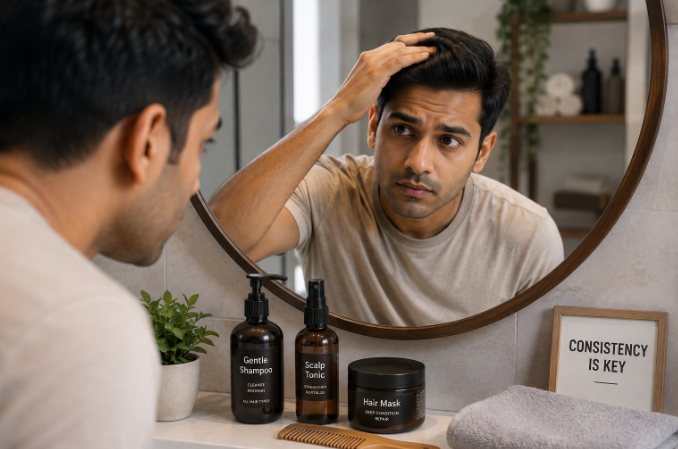
SURAT — Most of the damage a stylist sees was not done in a salon. It was done at home, in about ninety seconds, with a towel. Hair loses strength when wet: peer-reviewed testing on combing found a lower breaking load in wet hair because water plasticises the fibre, producing more long-segment breaks.
Note: Robbins C, Kamath Y, Journal of Cosmetic Science 2007.
Vinay Kumar Nevatia runs a hair studio in Surat, and says the routine matters more than anything on his retail shelf.
“People spend three thousand rupees on a serum and then rub their head with a bath towel,” he says. “The serum isn’t the problem.”
He is not against products. He sells them. His point is about sequence: a good conditioner cannot outrun a habit that breaks hair twice a day, and most clients arrive having optimised the expensive step while ignoring the free one.
Wet hair is the fragile part of the day
The American Academy of Dermatology puts it plainly: most people should handle wet hair as little as possible, because wet hair breaks more easily when combed or brushed, and a wide-tooth comb should be used instead of a brush to detangle it. The AAD also advises wrapping hair in a towel or t-shirt to gently absorb moisture, since roughly rubbing hair dry causes damage.
Note: American Academy of Dermatology, Hair styling without damage and Tips for healthy hair.
The mechanism is simple enough. Water absorption swells the hair shaft, and a swollen fibre under tension from a comb is not the same material as a dry one.
Note: Gavazzoni Dias MF, International Journal of Trichology 2015.
His own instruction to clients is a sequence rather than a rule. Squeeze, blot, wait, then detangle from the ends upward in sections, never from the roots down. Starting at the scalp drags every knot in the length into one compacted mass at the tips, which is where the breakage happens.
Shampoo goes on the scalp, conditioner on the ends
This is the correction Nevatia makes most often, and it is not a preference. AAD guidance is to apply shampoo to the scalp rather than the entire length of the hair, and for fine or straight hair to apply conditioner to the ends, extending it along the full length only if hair is dry or curly.
Note: American Academy of Dermatology, Tips for healthy hair.
On frequency, the same guidance splits by hair type. Straight hair with an oily scalp may want daily shampooing. Dry, textured, curly or thick hair may need it as little as once every two to three weeks.
“There’s no universal number, which is inconvenient for everybody selling one,” he says.
The reasoning behind the placement is structural. The scalp produces oil; the ends are the oldest part of the fibre and have been through years of sun, friction and heat. Treating both the same way over-cleans one end and under-conditions the other.
Vinay Kumar Nevatia on heat, and the study people quote wrongly
Heat is where he sees irreversible damage, and also where the most-repeated study gets mangled.
A Yonsei University experiment dried hair thirty times under five conditions and measured surface temperature: 47°C at 15 cm for 60 seconds, 61°C at 10 cm for 30 seconds, and 95°C at 5 cm for 15 seconds. Damage increased with temperature. Its conclusion was that although a hair dryer causes more surface damage than natural drying, using one at 15 cm with continuous motion causes less damage than drying naturally.
Note: Lee Y et al., Annals of Dermatology 2011. Two co-authors were affiliated with a hair-care manufacturer.
“That last line gets quoted as ‘blow drying beats air drying,'” Nevatia says. “It only holds at fifteen centimetres, moving. Held still against the scalp, the same paper says you’re doing more harm. People take the headline and leave the condition behind.”
Flat irons operate above 200°C, hot enough to damage hair keratin, and thermally stressed hair breaks significantly more under combing. Pretreatment with certain polymers reduced that breakage measurably, which is the best peer-reviewed support that heat protectants do something, though the study came from an ingredient supplier testing its own materials.
Note: Zhou Y et al., Journal of Cosmetic Science 2011. Supplier-funded research.
AAD’s own advice is a flat iron on dry hair, low or medium heat, no more than every other day.
Note: American Academy of Dermatology, Hair styling without damage.
The instruction he repeats most is about damp hair and hot tools. An iron closing on hair that has not fully dried turns residual water to steam inside the shaft, which is a different and worse kind of damage than dry heat.
Why Surat air undoes a blow-dry by lunchtime
Coastal Gujarat humidity is a physical problem, not a styling failure. Measured across relative humidity, hair water regain increases linearly between 40% and 85% RH, and remaining hair elasticity decreases linearly between 50% and 80% RH.
Note: Gao T, Journal of Cosmetic Science 2007. Author affiliated with an ingredient supplier.
Water breaks the hydrogen bonds in keratin, which is precisely the mechanism a blow-dry uses to reshape hair in the first place. Humid air simply reverses the same process.
Note: Gavazzoni Dias MF, International Journal of Trichology 2015.
“In August I stop promising anyone a smooth finish that survives the walk to the car,” he says. “I’d rather cut a shape that looks good with some texture in it.”
That shapes how he cuts through monsoon. Blunt lines and heavy weight lines fight humidity and lose visibly. A cut with some internal movement in it absorbs the swelling instead of announcing it.
Oiling, and one number to stop repeating
Pre-wash oiling is standard in most Surat households, and there is real evidence behind coconut oil specifically. A study comparing coconut, sunflower and mineral oils found coconut oil was the only one to reduce protein loss, for both damaged and undamaged hair, attributing this to lauric acid’s affinity for hair protein and its ability to penetrate the shaft.
Note: Rele AS, Mohile RB, Journal of Cosmetic Science 2003. Authors were affiliated with a coconut oil manufacturer.
The widely circulated figure that coconut oil reduces protein loss by 39% does not appear in that paper, and Nevatia will not use it.
“It’s manufacturer research and the number people quote isn’t even in it,” he says. “The finding is still worth knowing. The percentage is somebody’s marketing.”
He also pushes back on the champi tradition in one respect. Vigorous scalp massage on wet or fragile hair, and leaving heavy oil on for days before a harsh clarifying wash, are habits that undo the benefit they were meant to deliver.
Trims, shedding, and what a trim cannot do
A trim removes split ends before they travel. It does not change how fast hair grows, because the follicle sits below the skin and scissors do not reach it. The classic experiment on this shaved one leg weekly for months and found no difference in growth rate or hair width against the unshaved control.
Note: Lynfield YL, MacWilliams P, Journal of Investigative Dermatology 1970.
Worth knowing alongside that: AAD notes it is normal to shed between 50 and 100 hairs a day, and that brushing 100 strokes daily can cause split ends.
Note: American Academy of Dermatology, hair shedding guidance and Hair styling without damage.
That shedding figure resolves a lot of anxiety in his chair. Hair in the drain is expected. What is worth attention is a change in the amount, or hair coming out from one area rather than evenly.
When a stylist is the wrong person to ask
Nevatia is clear about where his job ends. Sudden shedding, patchy loss, persistent scalp itching, flaking or soreness are questions for a dermatologist, not a chair.
“I can tell you your ends are fried,” he says. “I cannot tell you why your parting is widening, and anyone in a salon who says they can is guessing with your hair.”
__________________________________________________
About Vinay Kumar Nevatia
Vinay Kumar Nevatia runs a hair studio in Surat covering cuts by face shape, hair care and everyday styling. More at vinaykumarnevatia.info.